
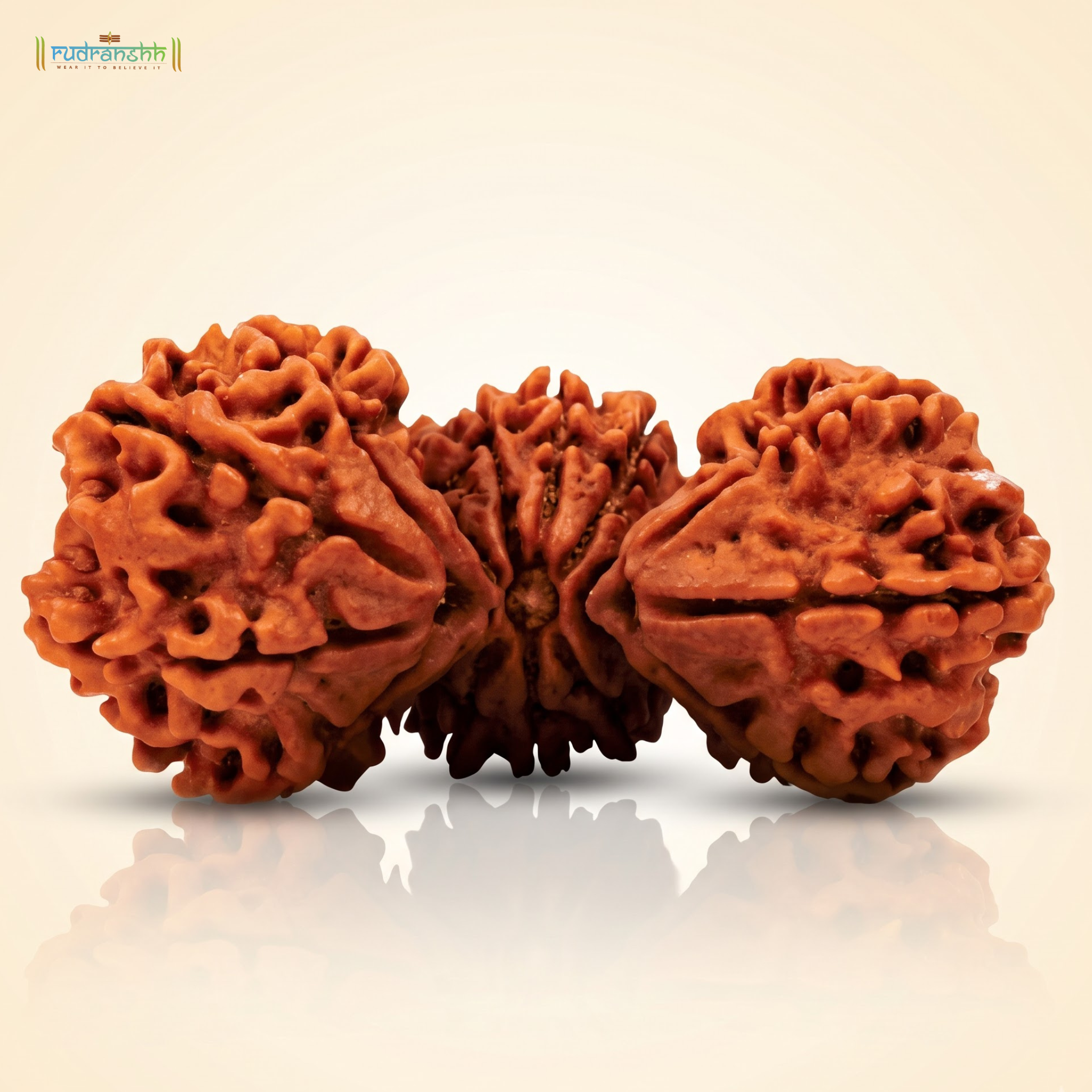
Trijuti Rudraksha
Trijuti Rudraksha, also known as Tribhagi or Gauri Path, is an exceptionally rare natural Rudraksha formation in which three Rudraksha beads grow naturally joined together as a single structure.
Traditionally, the three joined beads represent the Trimurti — Lord Brahma, Lord Vishnu and Lord Mahesh (Shiva) — symbolising creation, preservation and transformation.
Because of its rarity and distinctive natural formation, Trijuti should be presented by Rudranshh as a rare spiritual and collector-grade Rudraksha, with authenticity and actual-bead verification at the centre of the product experience.
Description
The name Trijuti refers to the union of three Rudraksha beads.
Unlike a normal Mukhi Rudraksha, Trijuti is defined by its natural three-bead formation, not by one fixed Mukhi number. Each individual portion can have its own Mukhi structure, so Rudranshh should record the actual Mukhi count of each bead when available.
Its traditional spiritual symbolism comes from the Trimurti:
Brahma → Creation
Vishnu → Preservation
Mahesh/Shiva → Transformation
Together:
Creation → Preservation → Transformation
This gives Trijuti a much deeper identity than simply calling it a “powerful Rudraksha.”
Traditional Significance
| Attribute | Details |
|---|---|
| Name | Trijuti Rudraksha |
| Also Known As | Tribhagi / Gauri Path |
| Associated Deities | Lord Brahma, Lord Vishnu & Lord Mahesh |
| Formation | Three naturally joined Rudraksha beads |
| Mukhi Count | Varies; record actual count of each bead |
| Traditional Theme | Creation, Preservation, Transformation & Spiritual Awareness |
Some current commercial traditions associate Trijuti with Venus, but this is not consistent enough for us to publish as a universal fact.
So again:
Planet → Panditji Confirmation Required
Traditional Benefits of Trijuti Rudraksha
These are traditional spiritual associations, not guaranteed outcomes.
Creation, Preservation & Transformation
The central meaning of Trijuti comes from the Trimurti.
It symbolises the three fundamental principles of:
Creating → Sustaining → Transforming
This makes it particularly meaningful for people experiencing major phases of change or building something significant.
Spiritual Awareness
Trijuti is traditionally regarded as a spiritually significant formation and is associated with deeper awareness and spiritual development.
Confidence & Inner Strength
Some traditional interpretations associate Trijuti with confidence, authority and the ability to approach significant responsibilities with greater conviction.
Leadership
Contemporary Rudraksha traditions often position Trijuti as meaningful for leaders, entrepreneurs and people carrying substantial responsibilities.
For Rudranshh, I would phrase this as:
A symbol of integrated leadership — the ability to create, sustain and transform.
That is much stronger than promising “power” or “victory.”
Purposeful Achievement
Traditional interpretations associate Trijuti with accomplishment and success in significant endeavours.
We should present this as traditional belief, not a guaranteed result.
Balance
The three-part structure can also be interpreted symbolically as balance between:
- Creation
- Preservation
- Transformation
This gives Trijuti a broader spiritual meaning than a purely prosperity-focused product.
Spiritual Practice
Because of its Trimurti association, it can be particularly meaningful for people interested in deeper Shiva, Vishnu and Brahma-oriented spiritual traditions.
Disclaimer: These are traditional spiritual and cultural associations. Trijuti Rudraksha should not be marketed as a guarantee of wealth, health, leadership, supernatural powers or specific life outcomes.
Mantra
This is one area where we should not blindly copy commercial sources.
Current sources use different approaches. One specialist source identifies Trijuti with the Trimurti but does not establish one universally accepted Beej Mantra. Another commercial tradition gives simply “OM” as the mantra.
Therefore, for Rudranshh:
Mantra → Panditji Approved
I strongly recommend that Panditji decide the exact mantra before we publish this product.
We should not put three different deity mantras together simply because Trijuti represents Brahma, Vishnu and Mahesh.
Who May Consider Trijuti Rudraksha?
Trijuti may be particularly meaningful for:
- Serious spiritual practitioners
- Entrepreneurs
- Leaders
- People undertaking major projects
- People going through major life transitions
- Individuals seeking deeper spiritual awareness
- People interested in Trimurti worship
- Collectors of rare Rudraksha formations
- People seeking a symbolic connection with creation, preservation and transformation
Rudranshh Free Recommendation
Because Trijuti is extremely rare and premium, we should not make customers decide based on a generic “benefits” list.
The journey should be:
Customer’s Purpose → Free Recommendation → Panditji Guidance → Appropriate Rudraksha
This is exactly where Rudranshh can become more than a normal Rudraksha store.
How to Wear Trijuti Rudraksha
The exact method varies according to spiritual tradition.
A simple traditional approach is:
- Clean the Rudraksha gently.
- Sit in a clean and peaceful environment.
- Offer prayers according to your spiritual tradition.
- Chant the Panditji-approved mantra.
- Wear or keep the Rudraksha respectfully.
Because Trijuti is such a rare formation, I recommend personalised Panditji guidance rather than presenting one ritual as mandatory for everyone.
Rudraksha Care
The three-bead natural formation requires extra care.
- Avoid harsh chemicals.
- Keep away from perfumes and cosmetics.
- Avoid prolonged exposure to water.
- Never pull or twist the three joined portions.
- Do not attempt to separate the beads.
- Do not scrape or polish the natural joints.
- Handle carefully during wearing and removal.
- Store in a clean, dry place when not being worn.
Product Specifications
| Specification | Details |
|---|---|
| Product | Trijuti Rudraksha |
| Also Known As | Tribhagi / Gauri Path |
| Associated Deities | Brahma, Vishnu & Mahesh |
| Formation | Three naturally joined Rudraksha beads |
| Traditional Theme | Creation, Preservation, Transformation & Awareness |
| Certification | If available |
FAQ
What is Trijuti Rudraksha?
Trijuti Rudraksha is an extremely rare natural formation in which three Rudraksha beads grow naturally joined together as one structure. It is also known as Tribhagi or Gauri Path.
Which deities are associated with Trijuti Rudraksha?
The traditional association is with the Trimurti — Lord Brahma, Lord Vishnu and Lord Mahesh (Shiva).
What does Trijuti Rudraksha represent?
It symbolises the three principles of:
Creation → Preservation → Transformation
Does Trijuti have a fixed Mukhi number?
No.
Trijuti is identified by its three-bead natural formation, not a fixed Mukhi count. The actual Mukhi count of each individual section should be recorded separately.
Is Trijuti Rudraksha rare?
Yes. Natural three-bead formations are considered exceptionally rare. Current sources specifically describe Trijuti as one of the rarest natural Rudraksha formations.
Why is Trijuti Rudraksha expensive?
Its rarity, natural three-bead formation and difficulty of authenticating genuine examples contribute to its premium positioning.
Can three Rudrakshas be artificially joined?
Yes. Artificially joined beads are a known concern in the market, which is why individual verification is particularly important for Trijuti.
How can I identify an original Trijuti Rudraksha?
Look for three naturally fused Rudraksha sections with an organic continuous formation and no signs of artificial joining. For a high-value purchase, Rudranshh should provide product-specific laboratory/X-ray documentation where available.
What is the mantra for Trijuti Rudraksha?
Different traditions give different mantras. Rudranshh should publish the single mantra approved by Panditji rather than combining different traditions.
Who may consider Trijuti Rudraksha?
It may be particularly meaningful for serious spiritual practitioners, leaders, entrepreneurs, collectors and people undertaking major personal or professional transformations.
How can I choose the right Rudraksha?
If you’re unsure whether Trijuti or another Rudraksha is appropriate for your purpose, use:
Rudranshh Free Recommendation →

Reviews
There are no reviews yet.