
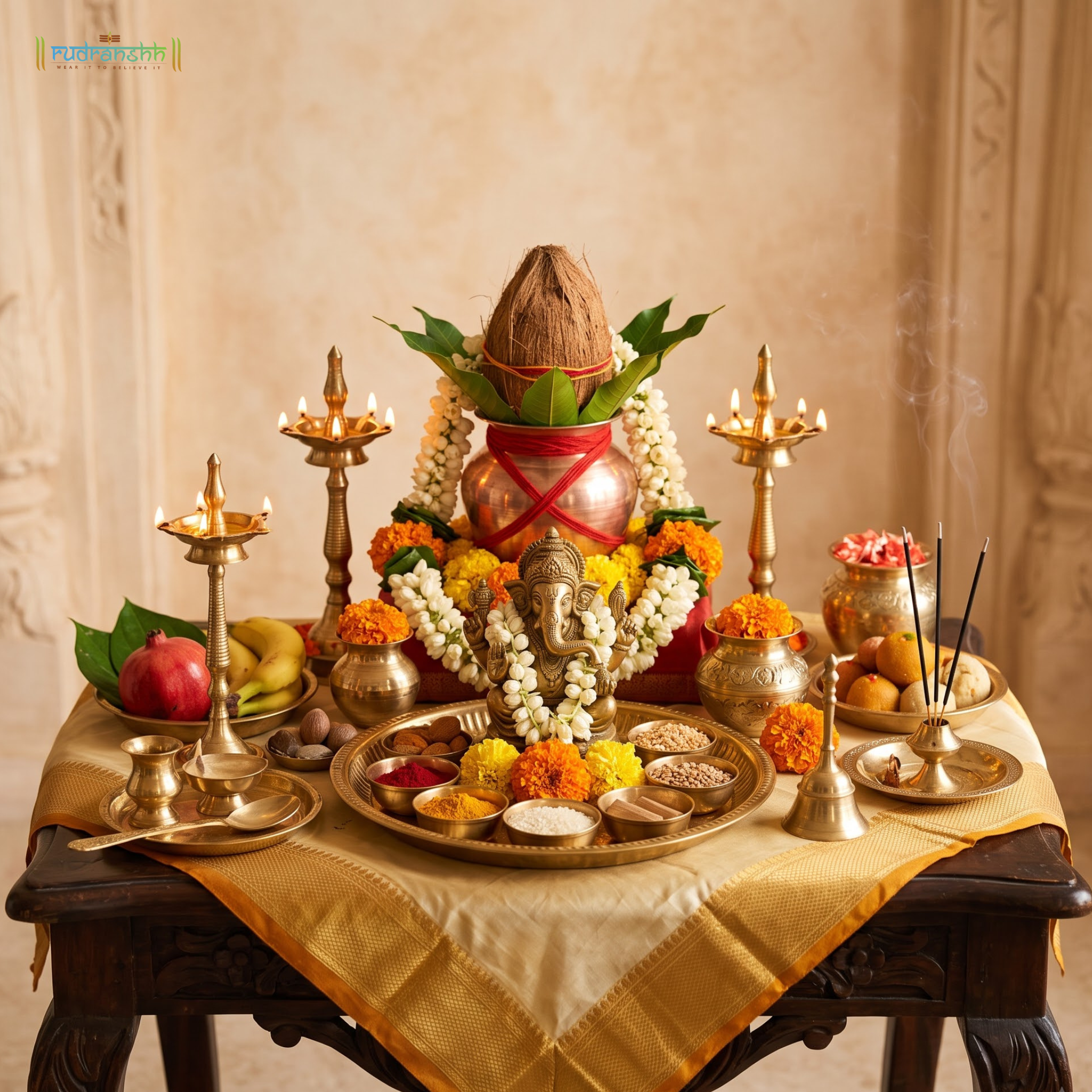
Special Pooja
Special Pooja is a curated collection of traditional Hindu rituals performed for important occasions, festivals, personal intentions, family blessings and special spiritual Sankalps.
These Poojas may be connected with a particular Deity, Tithi, Festival, Life Event, Temple Tradition or Personal Sankalp.
At Rudranshh, each Special Pooja should clearly explain why it is performed, what the ritual includes, where it is performed and how the devotee can participate.
If you are unsure which Puja is appropriate for your purpose, Rudranshh’s Free Panditji Recommendation can guide you.
Description
What Is Special Pooja?
“Special Pooja” should be treated as a dynamic collection, not one fixed ritual.
It gives Rudranshh the flexibility to offer:
Festival Poojas
Pujas connected with important festivals and sacred occasions.
Examples may include:
- Diwali Pooja
- Akshaya Tritiya Pooja
- Navratri Pooja
- Janmashtami Pooja
- Ganesh Chaturthi Pooja
- Mahashivratri Pooja
Tithi-Based Poojas
Special rituals connected with particular Hindu lunar dates.
Examples:
- Ekadashi
- Purnima
- Amavasya
- Pradosh
- Sankranti
- Other significant Tithis
Deity-Specific Poojas
Special worship dedicated to a particular deity.
Examples:
- Ganesh Pooja
- Lakshmi Pooja
- Durga Pooja
- Hanuman Pooja
- Vishnu Pooja
- Shiva Pooja
Life-Event Poojas
Pujas associated with important personal or family milestones.
Examples:
- New Business
- New Home
- Marriage
- Birthday
- Anniversary
- Career Beginning
Family Sankalp Poojas
Special Poojas performed with a family-specific intention.
Temple-Specific Special Poojas
Where Rudranshh has a genuine temple partnership, special rituals can be offered directly through that temple.
This model is already used by online devotional platforms, where temple-specific and occasion-specific special pujas are offered remotely.
Rudranshh Special Pooja Philosophy
The most important thing:
Don’t create random “Special Pooja” products just to increase the catalogue.
Every Special Pooja should answer:
Why this Puja?
For whom?
On which occasion?
Which deity?
Which tradition?
Who performs it?
Where is it performed?
What does the customer receive?
This is especially important because current online platforms can have dozens of occasion-specific pujas.
Rudranshh should instead have a small, highly curated collection.
Why Perform a Special Pooja?
Important Life Moments
A Special Pooja can provide a meaningful spiritual way to mark:
- A new beginning
- Marriage
- Birthdays
- Anniversaries
- New business
- New home
- Career milestones
- Family occasions
Festivals
Certain Poojas can be offered specifically around major festivals and sacred days.
Personal Sankalp
A devotee may wish to perform a particular Puja for a personal or family intention.
Deity Worship
Customers may want to offer worship to a specific deity without needing a complicated astrological recommendation.
Temple Tradition
Some customers specifically want their Sankalp performed at a particular sacred temple.
This is where Temple Pooja and Special Pooja can eventually connect.
Special Pooja Categories
For the website, I recommend filters rather than a massive list.
By Purpose
Peace & Well-Being
Prosperity
Family
Marriage
Career & Business
New Beginnings
Spiritual Growth
Protection
Ancestor / Pitru
By Deity
Shiva
Ganesha
Vishnu
Lakshmi
Durga
Hanuman
Surya
Other
By Occasion
Festival
Tithi
Birthday
Anniversary
New Home
New Business
Special Sankalp
By Location
Online
Temple
Panditji at Designated Location
Only show options that Rudranshh actually supports.
Special Pooja Discovery
This is where I would make the UX much better than a traditional puja website.
Instead of:
“Here are 50 Poojas. Choose one.”
We ask:
What would you like to seek blessings for?
❤️ Family & Relationships
Harmony, marriage, family blessings.
💰 Prosperity & Business
New business, growth, prosperity.
🏠 Home & New Beginnings
New home, housewarming, new phase.
🕉️ Spiritual Growth
Shiva, Vishnu, Devi and other spiritual practices.
🌸 Festival & Tithi
Special occasions according to the Hindu calendar.
🛕 Temple Seva
Special temple-based Poojas and offerings.
❓ I’m Not Sure
Get Free Panditji Recommendation
This last option should be extremely prominent.
Rudranshh Special Pooja Journey
01 — Choose Your Purpose
Customer doesn’t need to know the Sanskrit name of the Puja.
↓
02 — Explore Recommended Poojas
Rudranshh displays relevant options.
↓
03 — Read About the Puja
Customer sees:
Deity
Purpose
Occasion
Traditional significance
Vidhi
Duration
Location
What is included
↓
04 — Share Sankalp
Collect required details.
↓
05 — Select Date
Available dates / Muhurat.
↓
06 — Confirm Booking
Secure checkout.
↓
07 — Puja Performed
Panditji/temple performs the selected ritual.
↓
08 — Experience & Proof
Where included:
Live Participation
Photos
Video
Sankalp Confirmation
↓
09 — Prasad
If included:
Puja → Prasad → Packing → Shipping → Tracking
Current online puja services commonly combine live participation, personalised Sankalp and Prasad delivery, so this is now an established customer expectation in the category.
Personalised Sankalp
This should be a major Rudranshh feature.
Your Puja. Your Sankalp.
Customer should be able to provide:
Full Name
Family Names
Gotra
Purpose
And where relevant:
Date of Birth
Time of Birth
Place of Birth
Current online services already use customer names and gotra in Sankalp.
But don’t ask for every field for every Special Pooja.
The form should be ritual-aware.
Special Pooja Product Page
Every individual Special Pooja should follow one consistent template.
Hero
Puja Name
One-line purpose.
Date / Occasion
Temple / Location
Price
Book This Puja
Why This Puja?
Short explanation of the traditional purpose.
About the Puja
Detailed background.
Traditional Significance
What the ritual represents.
Who May Consider It?
Relevant audience.
Puja Vidhi
Only actual Panditji-approved ritual steps.
What’s Included?
For example:
- Panditji
- Sankalp
- Puja Samagri
- Mantra Jaap
- Havan
- Live participation
- Photos
- Recording
- Prasad
Only show what is actually included.
Date & Muhurat
Actual available date.
Temple / Panditji
This should be a strong trust block.
After the Puja
Show exactly what happens.
FAQ
Purpose, participation, Sankalp, Prasad, date, cancellation.
Special Pooja Pricing
I would avoid:
“Special Puja — ₹999”
without context.
Instead:
Starting From ₹____
What’s Included
Duration
Number of Pandits
Location
Sankalp
Prasad
Live Participation
This is much more transparent.
And for temple-specific special Poojas, pricing should be based on the actual temple seva fee + Rudranshh service, not an arbitrary markup hidden inside a generic package.
Trust Architecture
Special Pooja is where trust matters most.
Every product should show:
👨🦳 Panditji / Temple
Who is performing it?
🛕 Location
Where is the ritual being performed?
📜 Tradition
Which Vidhi / Sampradaya?
🪔 Ritual
What exactly is being performed?
👤 Sankalp
Whose name is included?
🎥 Participation
Live / on behalf / recording?
📸 Proof
Photos/video if included.
📦 Prasad
Included or not?
This is the kind of transparency customers increasingly expect from online devotional services. Current platforms explicitly promote temple connections, live participation and Prasad/confirmation as part of their experience.
Important: Special Pooja Should Be Dynamic
This is the biggest architectural decision.
Don’t hard-code 30 Special Pooja products into the website design.
WooCommerce should allow us to add a new Special Pooja easily.
For every new Pooja, admin enters:
Puja Name
Deity
Purpose
Occasion
Tithi
Date
Location
Panditji
Description
Traditional Significance
Vidhi
Duration
Price
Sankalp Fields
Live Available?
Prasad Included?
Photos
FAQ
SEO
Then the website automatically displays it inside the appropriate filters.
This is exactly the kind of scalable WordPress + WooCommerce + Elementor architecture we should build.
Seasonal Special Pooja
This category also gives Rudranshh an excellent repeat-purchase mechanism.
For example:
Mahashivratri
Special Shiva Pooja
↓
Navratri
Devi Special Pooja
↓
Diwali
Lakshmi-Ganesh Pooja
↓
Guru Purnima
Guru-related Special Pooja
↓
Shravan
Shiva Special Poojas
↓
Pitru Paksha
Pitru-related Poojas
This creates seasonal commerce without changing the core website architecture.
Current devotional platforms already use date/tithi-driven Special Pooja collections and event-based offerings.
Free Recommendation Integration
This should be everywhere.
Not Sure Which Special Puja Is Right For You?
Tell us:
“What would you like to seek blessings for?”
Then:
Get Free Recommendation
This creates:
Traffic → Lead → Panditji → Recommendation → Puja → Customer
instead of:
Traffic → Browse → Confused → Leave
This is one of the biggest commercial opportunities in your entire Pooja category.
FAQ
What is a Special Pooja?
Special Pooja refers to curated traditional rituals performed for particular festivals, Tithis, deities, occasions, life events or personal Sankalps.
How is Special Pooja different from Rudrabhishek?
Rudrabhishek specifically focuses on Lord Shiva and Shiva Lingam Abhishek.
Special Pooja is a broader category containing different occasion- and purpose-specific rituals.
How is Special Pooja different from Navgraha Pooja?
Navgraha Pooja specifically focuses on the nine Navagraha.
Special Pooja can be dedicated to many different deities, festivals, occasions or Sankalps.
Can I book a Special Pooja for my family?
Yes, where the selected Puja supports family Sankalp.
Can I choose a specific deity?
Yes, if Rudranshh offers that particular Special Pooja.
Can I book a Special Pooja online?
Yes, where the specific service supports online booking.
Will I participate live?
This depends on the individual Puja. Every product page should clearly state whether it is live, performed on your behalf, or both.
Will my name be included in the Sankalp?
Where personalised Sankalp is included, yes, according to the information requested during booking.
Will I receive Prasad?
Only if Prasad is included in that specific Special Pooja.
Can I request a Puja that isn’t listed?
This is actually an excellent Rudranshh feature.
Request a Special Puja
Customer submits:
Puja / Deity / Purpose / Preferred Date
and the Rudranshh team/Panditji responds.
This turns missing catalogue items into lead opportunities.
I don’t know which Puja I need. What should I do?
Don’t guess.
Get Free Recommendation from Panditji →
Tell us your purpose and let Rudranshh guide you.
Reviews
There are no reviews yet.