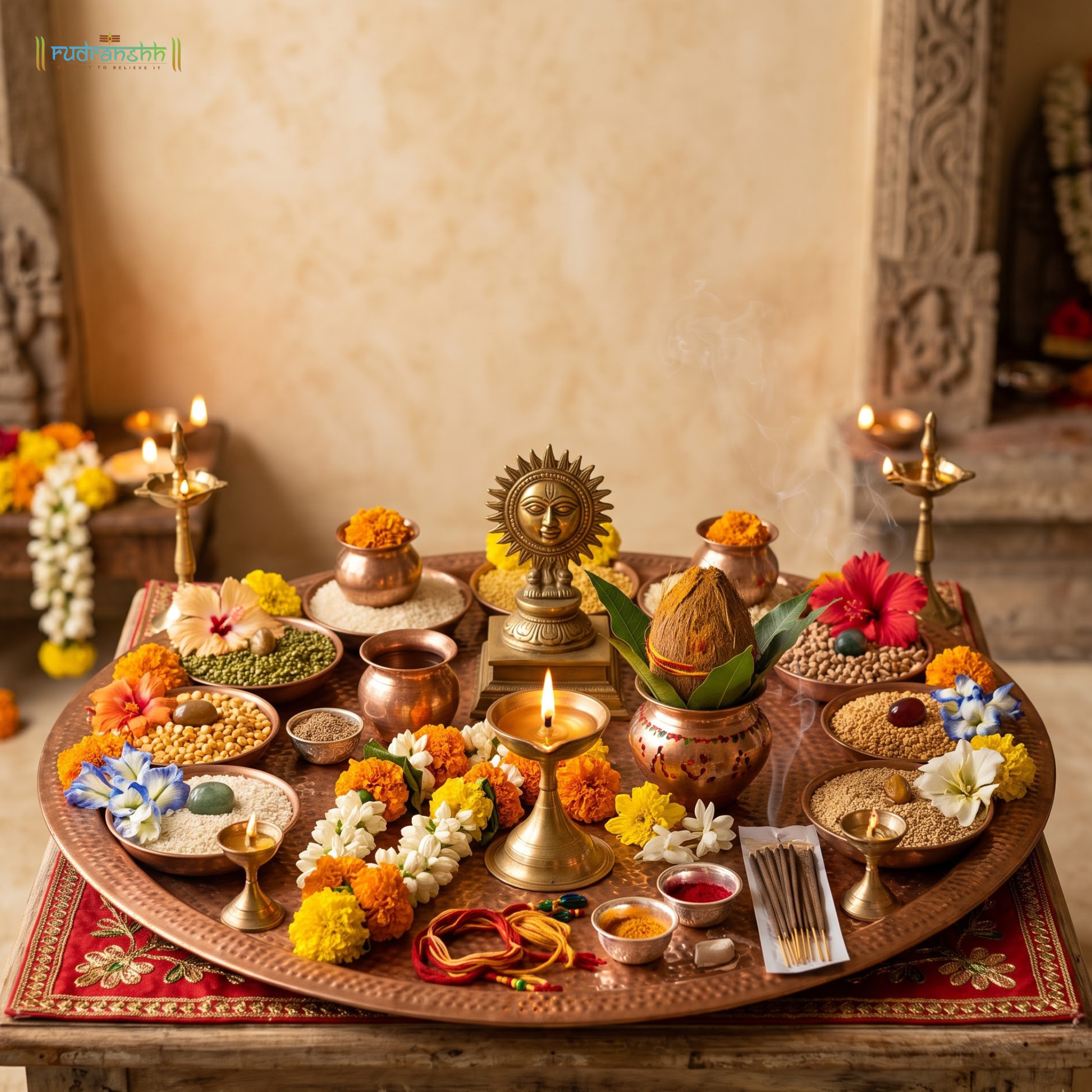
Navgraha Pooja
Navgraha Pooja is a traditional Vedic worship performed for the nine Navagraha — Surya, Chandra, Mangal, Budha, Guru, Shukra, Shani, Rahu and Ketu.
The puja is traditionally performed to seek peace, balance, harmony and auspiciousness in relation to the Navagraha. It may be undertaken during important life phases, before significant beginnings, or as part of a devotee’s regular spiritual practice. Traditional Navagraha rituals involve invocation and worship of the nine Grahas, with specific mantras and offerings.
Rudranshh Recommendation: customers should not be expected to diagnose their own planetary issue. If they are unsure whether they need Navgraha Pooja, Grah Shanti or another puja, they should be directed to Free Panditji Guidance.
Description
What is Navgraha Pooja?
In Vedic tradition, Navagraha refers to nine celestial influences worshipped as part of Hindu religious and Jyotisha traditions.
They are:
| Graha | Traditional Name |
|---|---|
| ☀️ | Surya — Sun |
| 🌙 | Chandra — Moon |
| 🔴 | Mangal — Mars |
| 🟢 | Budha — Mercury |
| 🟡 | Guru / Brihaspati — Jupiter |
| ⚪ | Shukra — Venus |
| ⚫ | Shani — Saturn |
| ☊ | Rahu |
| ☋ | Ketu |
Rahu and Ketu are traditionally included in the Navagraha even though they are lunar nodes rather than physical planets in the modern astronomical sense.
A traditional Navagraha Puja involves invoking and worshipping these nine Grahas, with specific prayers/mantras and offerings. A temple ritual description from the Indira Gandhi National Centre for the Arts also describes the Grahas being invoked individually and worshipped with Vedic hymns and offerings.
Why Perform Navgraha Pooja?
Seeking Planetary Harmony
The primary traditional purpose is to seek harmony and peace in relation to the Navagraha.
Rather than saying “this puja fixes your planets,” Rudranshh should use:
A traditional prayer for balance and auspiciousness.
Before Important Beginnings
Navagraha worship is traditionally performed on auspicious occasions and can be incorporated into important ceremonies.
This gives us an excellent Rudranshh use case:
New Business
New Home
Marriage
Career Beginning
Major Life Transition
Important Family Occasion
During Difficult Phases
If a person believes they are going through a challenging planetary period, Navgraha worship may be considered as a traditional spiritual remedy.
However:
Customer → Panditji Assessment → Recommendation
not:
Customer Googles “bad Shani” → automatically buys Navgraha Pooja.
Seeking Peace & Well-Being
Devotees may perform the puja simply with the intention of seeking peace, stability and auspiciousness for themselves or their family.
Traditional Significance
| Attribute | Details |
|---|---|
| Puja | Navgraha Pooja |
| Also Known As | Navagraha Puja |
| Primary Focus | Nine Grahas |
| Grahas | Surya, Chandra, Mangal, Budha, Guru, Shukra, Shani, Rahu, Ketu |
| Traditional Purpose | Harmony, Peace & Auspiciousness |
| Mantra | Individual Navgraha Mantras |
| Sankalp | According to Rudranshh/Panditji Vidhi |
| Havan | According to selected Vidhi |
| Online | According to actual Rudranshh service |
| Prasad | According to actual Rudranshh package |
Traditional Benefits
These should be presented as traditional beliefs, not guaranteed outcomes.
Peace & Harmony
Navgraha worship is traditionally performed with the intention of establishing greater peace and harmony.
Seeking Relief From Planetary Difficulties
Where a qualified astrologer or Pandit identifies a difficult planetary influence, worship of the relevant Graha may be recommended.
Auspiciousness
Navgraha Puja can be performed before important events with the intention of beginning them under auspicious circumstances.
Spiritual Discipline
The ritual brings together:
Sankalp + Mantra + Puja + Offerings + Devotion
creating a structured spiritual experience.
Family Well-Being
Navgraha Pooja can also be performed with a family sankalp when the intention is collective peace and well-being.
Inner Balance
The nine-Graha framework can be presented as a spiritual practice encouraging reflection, discipline and balance rather than promising that planetary forces mechanically control every outcome.
Rudranshh Disclaimer: Navgraha Pooja is a traditional religious practice. It should not be presented as a guaranteed cure for disease, guaranteed financial success, guaranteed marriage, removal of all doshas, or a replacement for medical, legal or financial advice.
Navgraha Pooja vs Grah Shanti Pooja
This distinction should be very clear on the website.
Navgraha Pooja
All Nine Grahas
Best positioned for:
- General Navgraha worship
- Auspicious beginnings
- General spiritual practice
- Family prayer
- Seeking overall harmony
Grah Shanti Pooja
Personalised / Concern-led
Best positioned when:
- Customer has a specific concern
- Kundli-based guidance is required
- A particular planetary influence is being considered
- Panditji recommends a specific Shanti ritual
UX
Customer sees:
Not sure which one is right for you?
Get Free Panditji Recommendation →
This is exactly how we should use your Free Recommendation system to capture leads.
Who May Consider Navgraha Pooja?
It may be particularly meaningful for:
- Families seeking collective blessings
- People beginning a new phase of life
- Entrepreneurs starting a business
- People moving into a new home
- Couples preparing for marriage
- Individuals seeking general Navgraha worship
- Devotees preparing for important events
- People who have been advised to perform Navgraha worship by their Pandit/Astrologer
- Spiritual seekers
What Information Should We Collect?
For Rudranshh, I recommend keeping the booking form simple but intelligent.
Step 1 — Customer Details
Full Name
Mobile Number
Step 2 — Puja For
Myself
Spouse
Child
Family
Other
Step 3 — Birth Details
If personalised guidance is included:
Date of Birth
Time of Birth
Place of Birth
Step 4 — Gotra
Gotra, if required by Panditji/tradition.
Step 5 — Sankalp
Instead of asking:
❌ “Which Graha is bad?”
Ask:
“What would you like to seek blessings for?”
Options:
- Peace & Harmony
- Family Well-Being
- Career
- Business
- Marriage
- New Beginning
- General Navgraha Shanti
- Spiritual Growth
- Other
This is much better UX.
Rudranshh Navgraha Pooja Journey
01 — Understand
Customer lands on:
Navgraha Pooja
They immediately understand:
All Nine Grahas • Traditional Vedic Worship • Personalised Sankalp
↓
02 — Choose Purpose
What are you seeking blessings for?
↓
03 — Share Details
Name + required birth details + Sankalp.
↓
04 — Panditji Review
Where personalised guidance is part of the service, Panditji determines the appropriate ritual approach.
↓
05 — Select Date
Show actual available dates.
↓
06 — Puja
Panditji performs the agreed Navgraha Puja.
↓
07 — Proof
Customer receives, where included:
Puja Confirmation
Photos
Video / Live Participation
Sankalp Confirmation
↓
08 — Prasad
If included:
Prasad Prepared → Packed → Shipped → Tracking
This is important because current online Navagraha services already use live virtual puja, Sankalp and personalised remedies as part of their service models.
What Can Be Included?
Do not publish these as final until Panditji confirms them.
| Service Element | Rudranshh Status |
|---|---|
| Navgraha Puja | ✅ Core |
| Sankalp | Confirm |
| Individual Graha Mantras | Confirm |
| Havan / Homam | Confirm |
| Puja Samagri | Confirm |
| Panditji | Confirm |
| Live Participation | Confirm |
| Recording | Confirm |
| Photos | Confirm |
| Prasad | Confirm |
| Certificate | Confirm |
| Shipping | Confirm |
This keeps the WooCommerce service page honest.
How Navgraha Pooja May Be Performed
A traditional ritual can include:
Ganapati Invocation
Beginning the ceremony with prayers to Lord Ganesha.
Sankalp
The devotee’s intention is stated.
Navgraha Invocation
The nine Grahas are invoked.
Individual Graha Puja
Each Graha is worshipped according to the selected Vidhi.
Navgraha Mantra
Relevant mantras are recited.
Offerings
Traditional offerings are made according to the ritual tradition.
Havan
If included, offerings are made into the sacred fire.
Aarti
The ceremony is concluded according to the Panditji’s tradition.
Traditional descriptions confirm the use of specific hymns/mantras, individual invocation and offerings in Navagraha worship.
Exact Rudranshh Vidhi → Panditji Approved
The Nine Grahas Section
This could become a beautiful interactive section on the final website.
Surya
Strength • Vitality • Leadership
Chandra
Mind • Emotional Balance • Peace
Mangal
Courage • Action • Determination
Budha
Intellect • Communication • Learning
Guru
Wisdom • Knowledge • Guidance
Shukra
Relationships • Beauty • Harmony
Shani
Discipline • Patience • Responsibility
Rahu
Ambition • Desire • Unconventional Paths
Ketu
Detachment • Spirituality • Inner Awareness
Important: These are broad traditional Jyotisha associations. They should not be presented as scientifically established effects.
Mantras
Navgraha worship uses individual mantras for the nine Grahas, rather than one universal Beej Mantra. Current traditional references provide separate mantra collections for Surya, Chandra, Mangal, Budha, Guru, Shukra, Shani, Rahu and Ketu.
For Rudranshh:
Don’t put all nine long mantras at the top of the product page.
Instead:
Navgraha Mantra Jaap → Panditji Approved
Then optionally create an expandable section:
View the Nine Graha Mantras
This keeps the product page premium and readable.
Online Navgraha Pooja
This can be one of the strongest parts of the Pooja business.
Possible models:
Live Online
Customer participates through video.
Puja on Your Behalf
Panditji performs the ritual using the customer’s Sankalp.
Live + Prasad
Customer participates remotely and receives Prasad.
Complete Personalised Experience
Birth Details → Panditji Guidance → Sankalp → Puja → Live/Recording → Prasad
We should only show the models Rudranshh actually offers.
FAQ
What is Navgraha Pooja?
Navgraha Pooja is a traditional Hindu/Vedic worship dedicated to the nine Navagraha: Surya, Chandra, Mangal, Budha, Guru, Shukra, Shani, Rahu and Ketu.
What are the nine Navagraha?
Sun, Moon, Mars, Mercury, Jupiter, Venus, Saturn, Rahu and Ketu.
Why is Navgraha Pooja performed?
Traditionally, it is performed to seek peace, harmony, auspiciousness and balance in relation to the Navagraha.
Is Navgraha Pooja the same as Grah Shanti Pooja?
Not necessarily.
Navgraha Pooja focuses on collective worship of all nine Grahas.
Grah Shanti is generally positioned around seeking Shanti/remedial guidance for particular planetary concerns.
Rudranshh can help determine which is more appropriate.
Do I need my Kundli?
Not necessarily for a general Navgraha Pooja.
If personalised astrological guidance is included, birth details may be requested.
Do I need to know which planet is causing a problem?
No.
That should be one of Rudranshh’s strongest UX messages.
Tell us your purpose. Let Panditji guide you.
Can Navgraha Pooja be performed online?
Yes, if Rudranshh offers an online version. The exact format—live participation or puja performed on the customer’s behalf—should be clearly stated.
Can I book Navgraha Pooja for my family?
Yes, if the selected Rudranshh service supports a family Sankalp.
Can I choose the puja date?
The available date should depend on Rudranshh’s actual scheduling system and, where relevant, Panditji’s recommended muhurat.
Does Navgraha Pooja remove all planetary problems?
We should not make this promise. It is a traditional spiritual practice and the outcome should not be guaranteed.
Will I receive Prasad?
Only if Prasad is included in the selected Rudranshh package.
Which Puja should I choose: Navgraha or Grah Shanti?
If you are unsure, use:
Get Free Recommendation from Panditji →
Reviews
There are no reviews yet.